
To Kill A Mockingbird is often cited as one of those books that many of us read at school and is on lists of books one ‘should’ have read and for me it had also made its way onto my theatrical bucket list following its 2018 adaptation, luckily this latest West End run finally gave me that opportunity.
The play follows lawyer Atticus Finch as he defends Tom Robinson, an innocent black man who is accused of rape in 1930s Deep South of America. Through Atticus and his two children Scout and Jem, along with their friend Dill the themes of racism, integrity and courage are explored, themes that remain every bit as relevant today as they were both in the 1930s when the story is set, and when Harper Lee first published the novel.
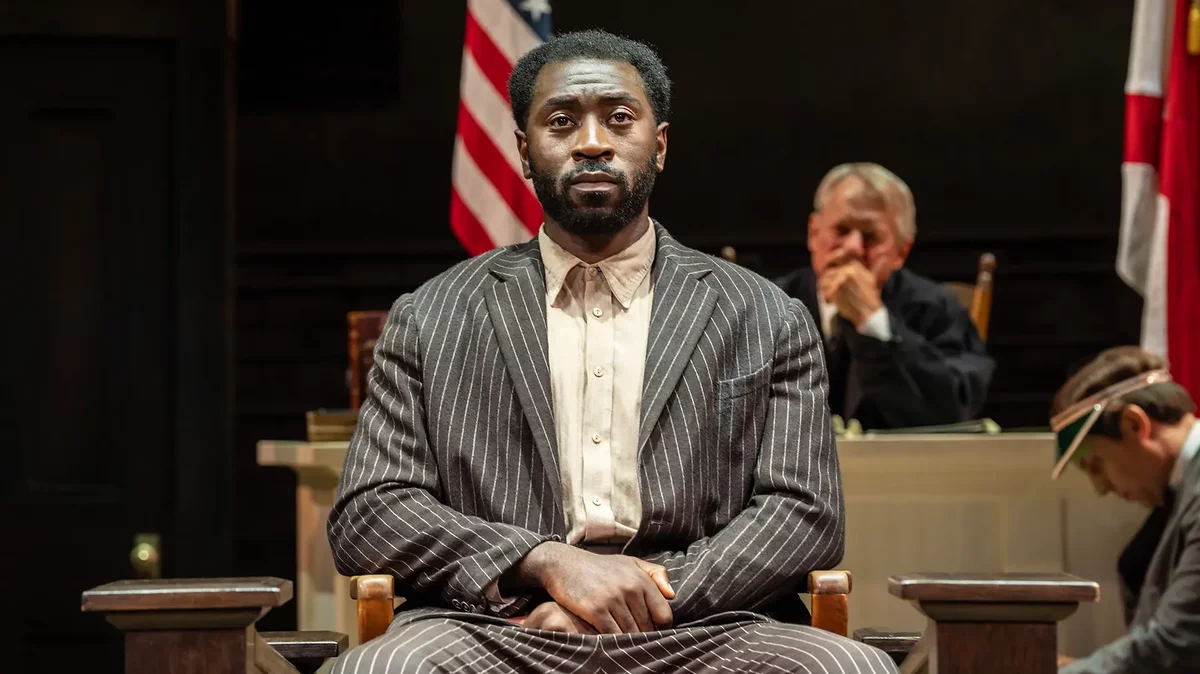
The play is structured around the trial of Robinson and flashes between the trial and occurrences before and after the trial, gradually revealing to the audience the full picture. This is a clever technique by playwright Aaron Sorkin as it keeps the audience’s intrigue high, gradually putting together the various pieces. I was completely drawn into the story and the 2 hours 50 minutes running time of the show flew by. Aaron Sorkin’s adaptation feels surprisingly witty despite heavy themes and really leans into the moral complexity of the characters, unafraid to challenge the audience with contradictions.
Much of the show is told through the perspective of Atticus’ children, which emphasises innocence and the 3 central children in the show display unforgettable performances. Scout, played by Anna Munden gives a masterclass in physicality as her childlike expressions and body language are bursting with personality. Within moments of her stepping on stage at the start of the show you get a real sense of her character. Her older brother Jem is played by Gabriel Scott and he portrays a boy on the cusp of adulthood, striving to do what is right but often with an air of innocence that hasn’t yet been worn away. Scott strikes this balance perfectly. Their friend Dill is played by Dylan Malyn whose portrayal of a young man with a troubled home life is moving in his queiter, more vulnerable moments but also in bringing a huge amount of energy to the stage.
Returning to the role of Atticus Finch was Richard Coyle who convinced as someone determined to do the right thing, even if it sometimes seemed that this ethos could be his undoing as easily as it could be his greatest strength. In a role that could be interpreted as preachy and sanctimonious Coyle steers the character to much more affable waters and particularly during the scenes with Dylan Malyn exploring Dill’s troubled home life were some of the most touching. Coyle also had an understated charm about him and was able to convey moments of humour and levity, especially in his dealings with his own children, which made his realisation of just how much he had underestimated the strength of the division in his local community even harder to witness. Compared to the book, the Finch housekeeper Calpurina, played by Andrea Davy, is given a larger role and she was interestingly able to hold a mirror up to Atticus. Whilst this role was expanded the role of Tom Robinson, played by Aaron Shosanya remained slightly underdeveloped, and it felt that the man at the centre of the trial feels overshadowed by those around him. The contrast between his dignified silence in the courtroom as his wife sits visibly moved behind him was a powerful image on stage.
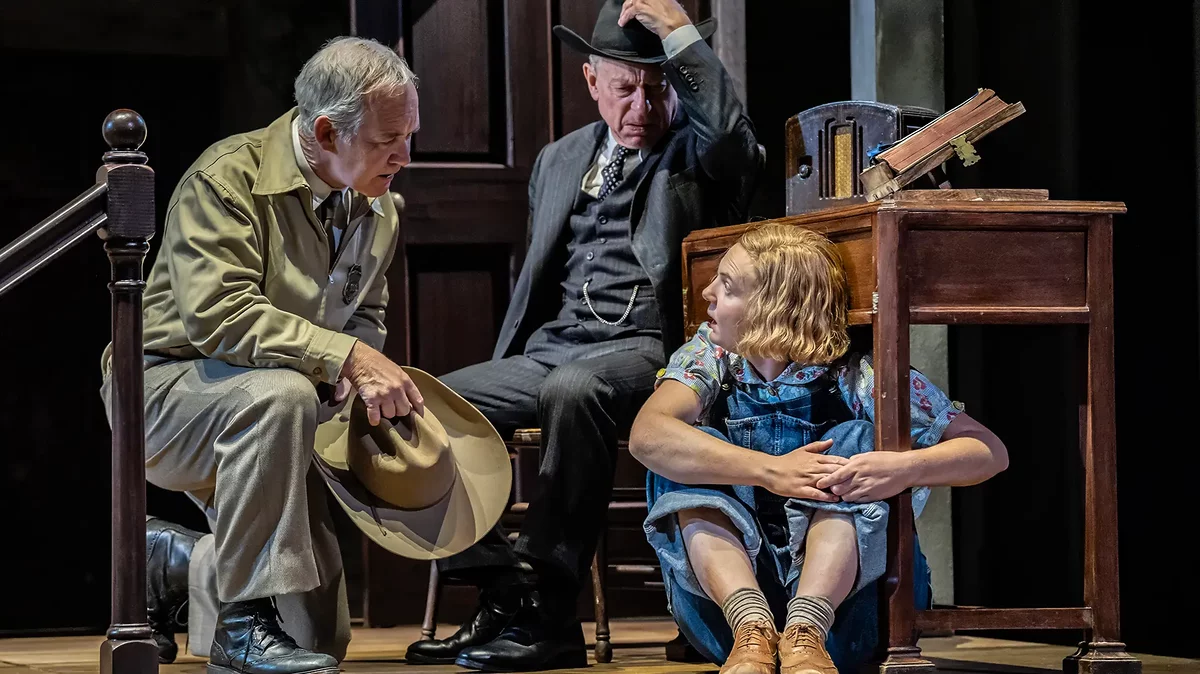
Directed by Bartlett Sher he succeeds in building tension where needed and the cross examination of Mayella Ewell, Tom Robinson’s alleged victim is a perfect example of this and when the children sit with the weight of the court room realisations each day the audience sit heavily with them but equally Sher allows for moments of levity and lightness in a wonderful contrast to this.
The set design is by Miriam Buether and we move from the steps of the Finch household to the courtroom swiftly and easily allowing the production to maintain its momentum without lengthy scene changes. Equally the lighting design is kept deceptively simple, serving to enhance the mood and let the plot do the talking but never breaking the naturalistic feel and flow of the production.
Ultimately, To Kill A Mockinbird is a production that trusts both its audience and its source material, Aaron Sorkin’s adaptation never loses sight of the humanity at the heart of Harper Lee’s story, while this cast ensure that the themes never feel like a history lesson but urgent conversations that still resonate today. Thought-provoking, emotionally engaging and anchored by a compelling central performance from Richard Coyle, this is a powerful piece of theatre that proves the most enduring stories are often those that continue to provoke thought decades after they were first told.
To Kill A Mockingbird is on at The Wyndhams Theatre until 12th September. You can find out more and book tickets here.
If you like this review you might also like my review of 1536, Archduke and Redcliffe